Between Fiction and Friction

There was a tweet going around a little while ago that said something to the effect of “With AI, everybody’s a writer.” I know we’re all sick of hearing about AGI – both its supposed miracles according to corporate PR and its very clear dangers according to everybody else – but I wanted to throw in a few thoughts of my own. Which basically boil down to: if you need something else to do the writing for you, you aren’t a writer. Writing is partly about the result, sure. But it’s more about the process.
There is a very simple test you can perform to tell you if you’re an artist at a professional level. Can you do the thing if you’re handed the most primitive method of accomplishing it? I do most of my drafting with a pen and a legal pad. A visual artist (penciler, painter, colorist, whatever) could do some pretty sick work with a pencil or pen or marker and a blank sheet of paper. A musician could play a nice song using a guitar or piano or a set of pots and pans. A filmmaker could make something cool using a super eight camera. Hell, a coder could probably write you a functional program on a napkin. Yes, I know a lot of people rely on technology for their chosen art form – VFX artists, electronic musicians, etc. The point stands: give them the most primitive version of the technology that they work with and they can still put together something coherent.
Here’s the thing, the dirty little secret that the AI bros don’t want you to know: anybody can do the above. Anybody can pick up a pen and paper and write a story or draw something, anybody can sing a song or pick up a guitar and play a primitive melody. You just probably won’t be able to do it well unless you’ve sunk a lot of hours of practice and work into it. And that’s okay! I love doodling little monsters in notebooks and singing in the shower. There’s joy in making art. Other people just might not be interested in experiencing it. Even then, though, there are folks who use their amateurishness to their advantage – look at XKCD or Daniel Johnston. I’d rather see human-made stick figures than beautifully rendered AI vomit.
Open AI and Anthropic and Microsoft all want you to think you need them as middlemen. They want to control the means of production, to coin a phrase. And it’s true – their machines can produce professional-passing work when prompted. But in that case, you aren’t a writer or painter or musician. You’re a prompter. You’re subservient to the machine. You aren’t learning anything except how to write better prompts. If/when AI goes away, so will your ability to prompt. You will not be able to pick up a pen and paper or guitar and produce anything at a professional level.
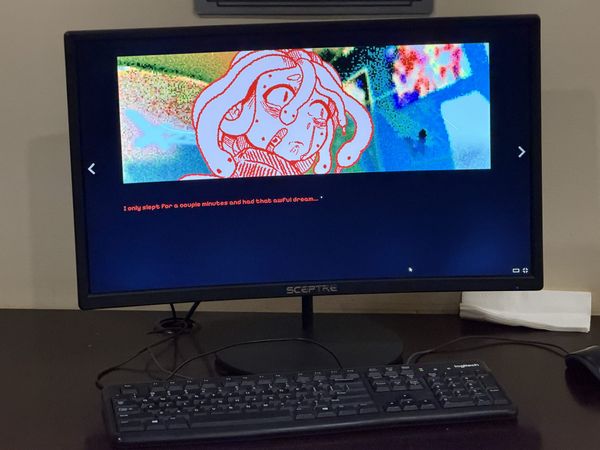
The lure of AI is that it allows you to skip over the process of making the thing. Like, when you pick up WAYPOINT, you see the finished product. You get four beautifully drawn, impeccably lettered, and entertainingly written comic book issues. You don’t see the dozens of drafts of the scripts, the tiny edits of individual lines to make them accomplish what I think they need to accomplish. You don’t see Jakub’s page sketches or my notes on the designs and page compositions. You don’t see all the discussions that I had with HdE about the right fonts to use and what color the word balloons should be. You don’t hear the discussions that I had with Dane about the right font to license for the logo. That’s why creators love to include examples of how a page goes from script to pencils to final version in the back of their trade paperbacks – and why I’ll be doing the same in the trade for WAYPOINT. Not only is it a great way to add pages to the book, it gives readers a peek into just how much work went into the project.
Creators love to talk about this magical thing called “the process.” The process is a simple thing: it’s the series of choices that led to the creation of the piece. AGI takes all those choices away from you and gives them to an algorithm, which is what’s so tempting and so insidious about it. Decisions are difficult! I get it. I hate making them. Handing them over to a machine keeps you from having to agonize over whether you should use “a” or “the” as the article in a sentence. But it’s also what makes AI creations slop. There’s no thought behind the choices made. It’s all arbitrary. Those decisions – even if they’re bad or wrong! – are what make art, for lack of a better word, human.
There’s an obvious strawman argument to be made: “but Jeff, you write scripts, isn’t that like prompting the artist? Isn’t that the same thing as prompting an AI?” Nice try, but no. Collaborating with other human beings is not the same thing. Essentially, by hiring an artist, I’m hiring somebody who knows how to make the right decisions in their field to bring the choices that I’ve made in my script to life. Choices all the way down. And choices you can have an intelligent debate with the other person about! None of the “oh, my mistake, you’re always right” feedback you get from an AI chat bot. That’s not collaboration. That’s sycophancy from a robot programmed to be a yes-man by psychopaths who can’t stand disagreement. It’s a really magical feeling to see another human being interpret your ideas and bring them to life. AI can offer you a simulacrum of that, but it’s empty.
It’s not even like it’s that much less work! I don’t use the stuff myself, but I hear from people all the time how much they had to wrestle with a prompt to get the AI to do what they wanted. Even if you’re trying to get it to do what feels like busywork, you aren’t enriching yourself by getting a robot to do it. Life is a process, and the process is life.
If you’d like to read a comic made entirely by humans, you can follow the prelaunch for my Kickstarter here:
https://www.kickstarter.com/projects/waypointcomic/waypoint-1-4
NOW SPINNING
Larry Coryell – Fairyland
Wicked Witch – Chaos 1978-86
Muna – Dancing on the Wall
Crown Lands – Apocalypse
Alaska y Dinarama – Canciones Profanas