Lord of the Underground

Finally, a newsletter where I’m not promoting my Kickstarter! That’s actually a lie, late pledges are still open so you can still get in on it. The key thing is that the campaign has closed, and I made over double the money I was hoping to get. I’ve learned a lot through this process. Some of it I’m still processing – working with friends can pose unexpected challenges. Some of it is more mundane, like logistical stuff. I’m definitely better prepared to run one of these again if I need to. Do I want to? Well, we’ll see when that situation arises.
I think the most important thing I learned from this whole experience was how key it is to build a core audience. By the end of the campaign, I was getting pledges from people whose names I didn’t recognize. Which is the goal, and hopefully due to word of mouth and the podcasts I appeared on! But at the beginning, it was people I knew. Not even necessarily friends and family – although those stepped up for sure. Instead, it was an obscure internet community that provided the backbone of the funding.
Observing comics crowdfunding, I’ve noticed a few things. One is that it seems like a lot of the money comes from creators supporting each other and passing the cash around. Which is fantastic! Put your money back into the community for sure (and speaking of, I have a few projects I need to go support in return myself). But that pool of money is, by nature, limited. So how do you bring in an untapped reserve? The answer is obvious, even if the means of actually doing it can be complicated: you have to reach outside the bubble.
I didn’t even set out to do it. It’s a weird thing to explain. I’ve been in chat rooms and message boards since high school. I tend to be solitary during the day so it’s a good way to get the experience of talking to co-workers without actually having to work with them.
Twitter fulfilled that role for a while, until it didn’t. And that’s been a big problem for a lot of creators – tech companies love playing Lucy with the football. It makes you feel really insecure to know that you could painstakingly build an audience and a reputation on a social platform only to have the owners arbitrarily lock everything behind obtuse algorithms or turn it into a feeding trough for right-wing lunatics. It seems impossible to get any traction on BlueSky and, even though I’m making videos for their feeds, Meta is a terrible place to promote things that aren’t your cat unless you pay them. Which, by the way, I tried to do and could not get their payment system to accept any of my credit cards. So that’s clearly not the best option.
I joined a Discord server a few years back for a comedy website I enjoy created by ex-Cracked.com writers. It’s mostly a place for me to bullshit about media and current events with a crew of (somewhat) like-minded folks. More complicated than that, of course – enough time spent chatting with people, even ones you’ve never met in real life, and you start to, like, care about them. Although the membership of that Discord is not as impressive a number as folks who have tens of thousands of Insta or TikTok followers, it turns out that the engagement rate is way, way higher.
I didn’t join expecting to find a customer base, by the way. But the more I talked about the project with folks, and the more I talked about the Kickstarter campaign itself, the more excited people got. Some of them kept bugging me about when it was gonna launch. And when it did, a ton of people from the Discord backed my book. Some even threw in extra! That’s how I was able to clear the goal in 12 hours. It turns out people who are willing to give money to comedy writers for funny articles are also willing to give it to comic writers for funny books.
So the question is, do those count as friends or an audience? Does the difference even matter? I may not have built the audience based on my work, but it (hopefully) translated to making new fans in addition to the online friendships I’d developed. We’ll see how people react to the book when it arrives in their mailboxes. I’m pretty proud of it and I definitely don’t intend to disappoint them.
The key takeaway is this is an audience of people that don’t normally back comics Kickstarters. I brought in a whole new untapped market. Do I know if they’re going to go back other books that aren’t mine? I know they’re aware of them – a lot of backers have been getting e-mails suggesting they follow comics projects of a more, um, adult nature. So that’s a start. Maybe they’ll get a suggestion for something cool that speaks to them.
I’m not saying go into random internet communities and embed yourself until you have something to promote. You need to find your people. This community recognized that I’m, for better or worse, one of them, and they supported their own. It wasn’t YouTube influencer numbers, but it was enough to make a huge difference for my comic. In a world where everything is mass-produced and impersonal, those personal connections make all the difference.
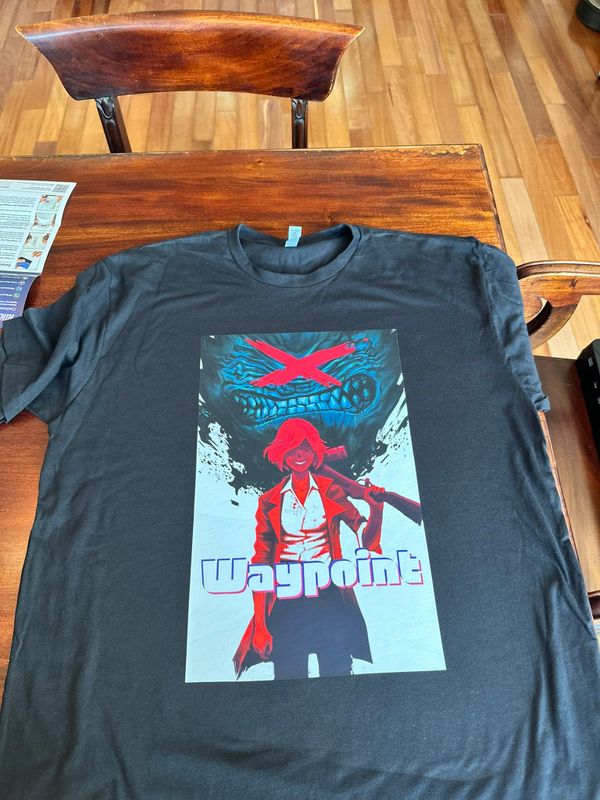
There are a few places I can go from here. Do I want to be somebody that entirely crowdfunds his comics? That’s a tricky question. The ultimate goal of Kickstarting WAYPOINT – other than getting it into people’s hands – is that I’m hoping it’ll open some doors for me with bigger publishers and opportunities. It’s a crowded field and packed with talented people already. This is my way of saying “Hey look, I’m here, too!” Thanks to my backers, I now have a seat at the table. Even if it’s a child’s highchair.
NOW SPINNING
Xeno and Oaklander – Topiary
Magma – BBC 1974 Londres
Icona Pop – Ritual
John Carpenter – Cathedral
Celtic Frost – To Mega Therion